
Blogs
How to Reply to a Legal Notice: Timelines, Format and Common Mistakes
👤 Liznr Legal
Oct 12, 2026

How to Reply to a Legal Notice: Timelines, Format and Common Mistakes
Receiving the legal notice is alarming, but it does not mean that the case has been decided against you. A legal notice is a formal communication that puts you on record about the claim, demand, breach, dispute, or proposed legal action. The right response depends on the nature of the notice, the deadline mentioned, the evidence available, and the legal remedy the sender can pursue.
Some notices may carry legal consequences and strict timelines, such as the cheque-dishonour notice under Section 138 of the Negotiable Instruments Act, 1881, or a notice under Section 80 of the Civil Procedure Code, 1908, before a suit against the government. The safe approach is to read the notice properly, preserve it in an envelope and delivery proof, consult with a qualified lawyer, and respond in writing within the deadline. Silence is not an admission of liability automatically, but an unanswered notice that can weaken your position on costs, credibility, and the record of the dispute.
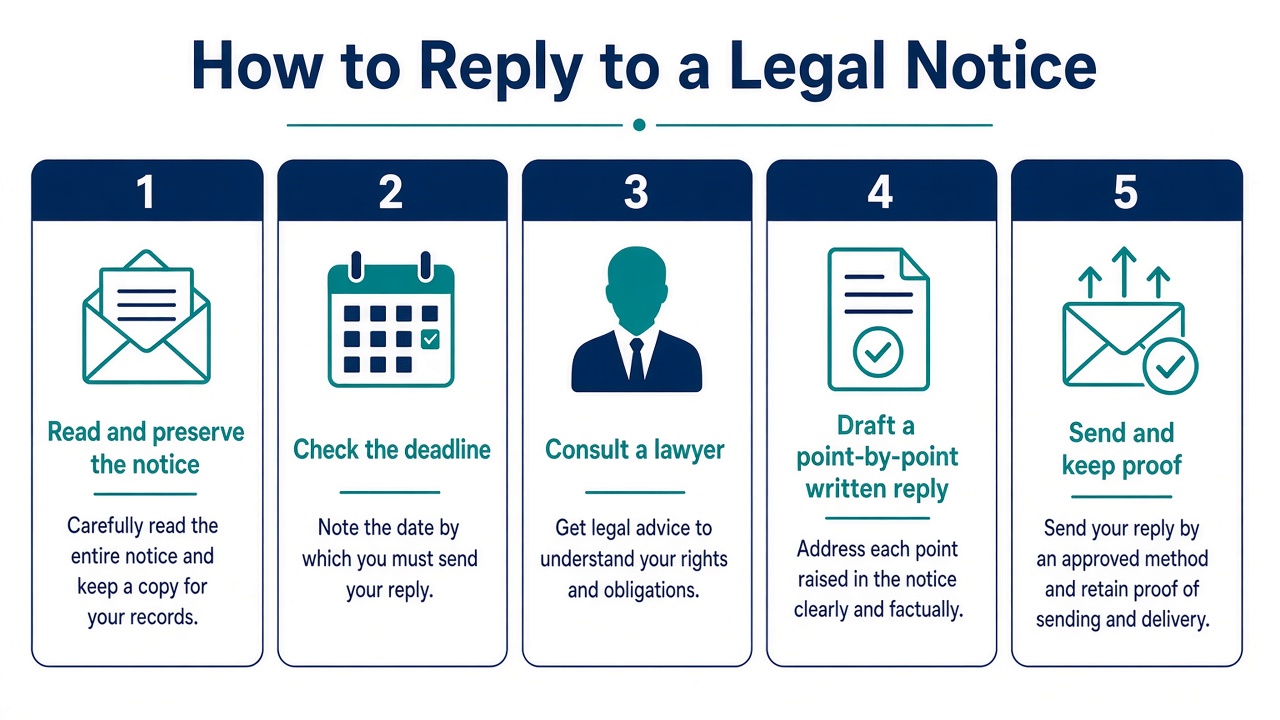
What a Legal Notice Means
A legal notice is a written message sent by an individual, a company, or by their lawyer to allow the other party to know about a complaint or to make a request. It can ask for payment, for the performance of a contract, for the retraction of statements, for the surrender of property, for compliance with an agreement, or for other particular action.
A notice can come before a civil suit, a consumer complaint, an action for cheque bounce, a recovery proceeding, or some other legal action. You must not regard each demand made in a notice as legally binding only because it is printed on the letterhead of an advocate.
Is there a universal deadline?
No, there is no general law that specifies a fixed period, like 7, 15, or 30 days, for responding to any legal notice. If a deadline is provided in the notice, then it should be taken seriously, but the consequences of failing to meet it will depend on the relevant law. The common timeline includes the
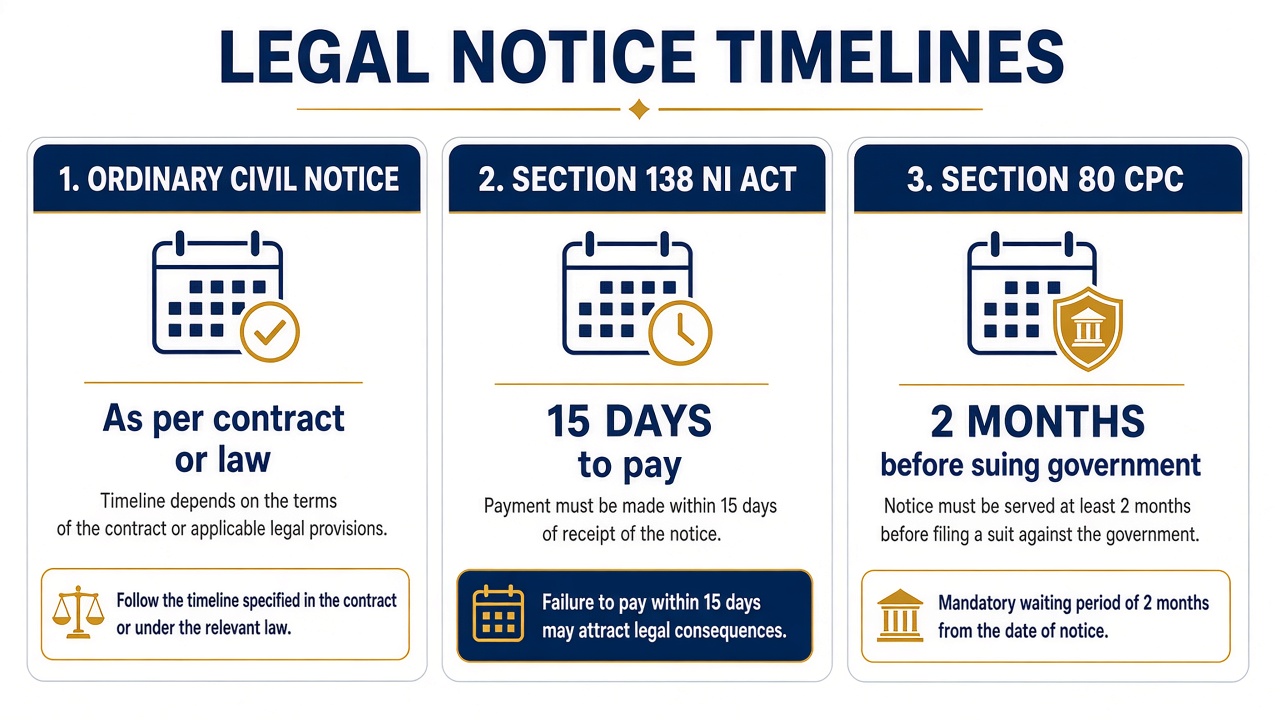
| Type of notice or situation | Usual timeline |
|---|---|
| Ordinary contractual or civil legal notice | As mentioned in contract, notice or applicable law |
| Cheque-dishonour notice under Section 138 NI Act | 15 days from receipt of notice to pay the cheque amount |
| Notice under Section 80 CPC before suing the government or a public officer | Two months after written notice is delivered or left at the prescribed office |
| Contractual notice clause | The period mentioned in the contract |
The two-month period provided under Section 80 CPC is not a deadline by which the government has to reply. It is mainly a waiting period during which certain legal actions against the government or public officers may be brought, although a court may allow an urgent or immediate-relief suit without prior notice in some limited cases.
The 15-day period stated in a notice under Section 138 of the NI Act is mainly intended as a time within which the person who has drawn the cheque should make the payment. It does not only serve as a deadline for sending a written explanation, because failure to pay during that period can result in the statutory effect of a cheque-bounce complaint, on the condition that the other requirements of Section 138 are satisfied.
Sample Reply Format
Here is the format on how you can reply to a legal notice
Subject: Reply to Legal Notice dated [date] issued on behalf of [sender's name]
Sir/Madam,
Under instructions from and on behalf of my client, [name], I hereby reply to your legal notice dated [date] as follows:
The contents of paragraph 1 are noted.
The contents of paragraph 2 are denied inasmuch as they are incorrect, misleading, and denied in toto.
My client denies that it committed any breach of the agreement dated [date]. The agreement was performed in accordance with its terms, and the documents annexed herewith establish compliance.
The demand for payment of Rs. [amount] is denied. My client is not liable to pay the said amount for the reasons stated herein.
Without prejudice to the foregoing, this reply is issued without prejudice to all rights, remedies, contentions, defences, and jurisdictional objections available to my client, all of which are expressly reserved.
Nothing in this reply shall be construed as an admission of any allegation, claim, or demand made in the notice.
My client reserves the right to take appropriate legal action and to add to or amend this reply at the appropriate stage.
A copy of this reply is retained in my office for record and further necessary action.
Yours faithfully,
[Advocate's name and signature]
Common Mistakes To Avoid
Here are the common mistakes to avoid while replying to a legal notice
Ignoring the Notice
Silence is not an admission in law. If you ignore a legal notice, it can be seen as showing indifference, allow the sender to create a record of your failure to respond, and may lead to unnecessary costs or interfere with your future proceedings.
When the deadline is very short, it is suggested to ask an advocate to send an interim acknowledgment or a preliminary reply in which rights are reserved, provided that a more complete response is prepared.
Replying Emotionally
You should not send angry messages, threats, accusations, or lengthy explanations by WhatsApp, email, or social media because these communications can be saved and used as evidence.
Ensure that all your communication remains professional. If the other party gets in touch with you personally, do not talk about the merits of the dispute without first seeking legal advice.
Making Unnecessary Admissions
You should not make statements such as "I agree I made a mistake," "I accept liability," or "I will pay the amount" unless you have obtained legal advice and have decided to make those admissions.
A rather simple message such as "I will deal with it soon" could be seen as an admission depending on the situation, so care should be taken when choosing your words, particularly in cases involving cheques, debt recovery, employment, and contracts.
Missing a Statutory Deadline
The worst error is failing to meet a deadline which has legal consequences. In a case under Section 138 of the NI Act, the drawer has 15 days from the date on which they receive the demand notice to make payment; if the other legal conditions are met, non-payment within that time can result in prosecution.
In a case governed by Section 80 of the CPC, the two-month period determines the time within which certain actions brought against the government or public officers may be started. A notice clause contained in a contract may also specify a deadline for curing a breach, terminating the agreement, bringing a claim, or responding to a notice.
Sending an Incomplete Reply
If your reply does not deal with the key accusations, does not mention the supporting documents, or does not include a reservation, then gaps may remain in your defence. You should ensure that each substantial allegation is responded to and that the relevant documents are clearly stated or attached.
Assuming a Lawyer's Letter Is a Court Order
A legal notice is not the same as a court summons, an arrest warrant, or a court order that can be enforced. You should not panic or make immediate payments just because the notice contains strong language, but you should not ignore it either; you must have a lawyer assess the claim, the deadline, the evidence, and the risk.
Conclusion
Although a legal notice must be taken seriously, it does not follow that your legal position has been lost. You should check the relevant deadline, understand the allegations, and get legal advice before you reply. When drafting your response, it is important to deal with each point made in the notice, explain or deny any incorrect claims, clarify the relevant facts and, where appropriate, reserve your rights and jurisdiction.
Do not give emotional replies, make unnecessary admissions or level unsupported allegations. If there are statutory time limits involved, for example under section 138 of the NI Act, you should act quickly to safeguard your position.
FAQs
- Is there a specific deadline to respond to each legal notice?
No, there is no general statutory deadline that applies to all legal notices. The time limit in question may vary according to the particular law, contractual terms, notice requirements, or circumstances. - What should a legal notice reply contain?
A legal notice reply must address the allegations point-by-point, deny incorrect claims, clarify the relevant facts, mention the legal provisions, respond to demands, and reserve your legal rights. - Does not replying to a legal notice mean I admit the allegations?
No, silence does not mean legal admission automatically. Ignoring the notice may affect your credibility negatively, costs, or how your conduct is presented during proceedings.
Share:
Table of Contents
No headings found in this post
Unlock smarter meetings with AI. Explore Liznr for product updates, success stories & collaboration insights.
Useful links
liznr.ai Blog
Check out the Liznr Legal blog for research, drafting and citation notes written for practising Indian advocates.
Subscribe to Our Newsletter