
Blogs
How to Read a Judgment: Breaking Down Ratio Decidendi, Obiter Dicta & Holding
👤 Vikram Singh
May 31, 2026

How to Read a Judgment: Breaking Down Ratio Decidendi, Obiter Dicta & Holding
Reading a court judgment is tough for the advocates and law students because legal citations, language, and lengthy reasoning make the actual decision hard to understand. To use judgments properly, you should understand some important concepts like Ratio Decidendi, Obiter Dicta, and Holding.
These concepts help you to identify the binding legal principle, separate general observations, and understand the final outcome of the case. You can also use the modern legal AI platforms like Liznr Legal to simplify this process. It helps lawyers analyze judgments, identify relevant precedents, map opposing citations, and structure legal research faster. Let us read this blog to know about these concepts, and a step-by-step framework to read legal judgments properly.
Why Understanding Judgments Matters
Making judgments is crucial because every legal issue depends on precedent. In order to interpret the law and settle conflicts, courts frequently refer to earlier judgments. But not every aspect of a judgment has the same legal weight. The biggest problem is that some newcomers consider the entire judgment as legally binding. However, some parts of the judgments actually have precedential power.
- What you must understand to make conclusions
- What legal matter did the court resolve
- Which observations served only as explanations
- Which logic resulted in a legally binding
- How the judgment will affect cases in the future
For this reason, while analyzing verdicts, legal experts carefully distinguish between ratio decidendi, obiter dictum, and holding.
Ratio Decidendi (The Reason for the Decision)
The primary legal principle or rule that influences the case's outcome is Ratio Decidendi. It is a legally binding portion of the judgment that courts in the future may use as precedent.
- How to find it: You should look at the court's responses to the primary legal questions and the logic that led to the ultimate judgment.
- How Liznr Legal assists: The Liznr Legal tool scans lengthy decisions using AI legal intelligence and Natural Language Processing (NLP). Additionally, it saves lawyers hours of manual study by highlighting the precise paragraphs that contain the court's main points.
Obiter Dicta
It is the judge's further remarks, analogies, observations, or hypothetical situations that are not essential to the case's decision that are referred to as obiter dicta.
- How to find it: The sections where the judge addresses hypothetical circumstances, more general legal concepts, or uses expressions like "even if," "suppose," or "hypothetically" are where you can locate the Obiter Dicta.
- How Liznr Legal helps: This tool keeps your attention just on the pertinent legal reasoning and keeps you prepared for cases by separating non-binding judicial remarks from the genuine binding precedent.
The Holding (The Final Order)
Holding is the court's ultimate practical conclusion or judgment concerning the disputing parties.
- How to find it: The holding, which shows whether the petition, appeal, or application was granted, denied, or altered, is located at the conclusion of the judgment.
- How Liznr Legal assists: This tool generates organized legal summaries and highlights the holding, relevant legal sections, case outcomes, and important precedents. It expedites the advocates' understanding of judgment.
Manual vs. Liznr Legal AI Workflow
Here is the comparison analysis of Liznr vs. the manual legal AI workflow.
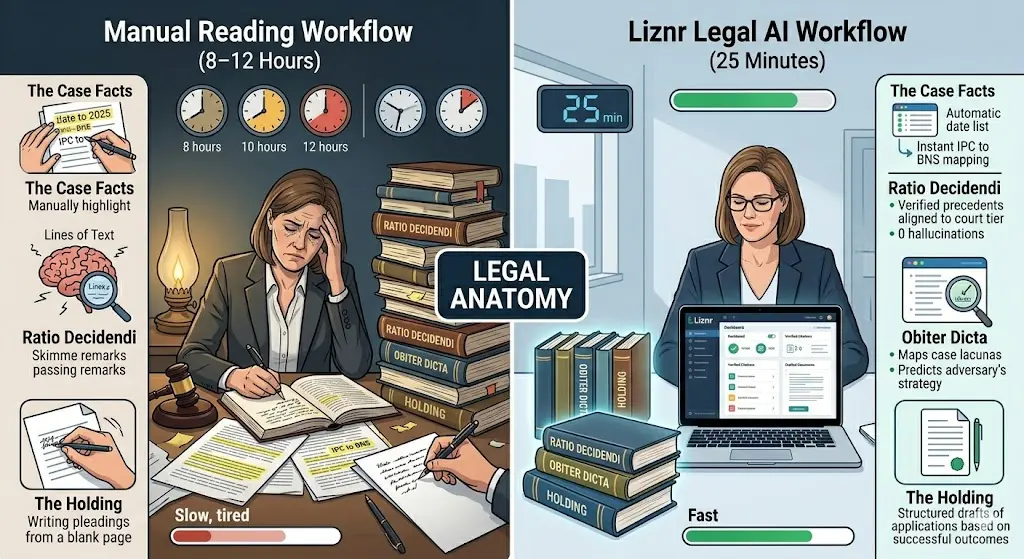
| Legal Anatomy | Manual Reading Workflow (8–12 Hours) | Liznr Legal AI Workflow (25 Minutes) |
|---|---|---|
| The Case Facts | Highlight dates manually and map out charges on hundreds of pages. | Generates a clean list of dates automatically and maps IPC to BNS charges instantly. |
| Ratio Decidendi | Tests various lines of text to find if they constitute the binding rule of law. | Curates real, verified precedents aligns to court tier and facts with zero hallucinations. |
| Obiter Dicta | Skimming passing remarks to find hidden risks or persuasive points. | Uses context to map out your case lacunas and predict your adversary's strategy. |
| The Holding | Review the final order and draft your own pleadings from a blank page. | Create structured drafts of applications and notices based on successful case outcomes. |
How to Read a Judgment Step-by-Step with AI
Reading judgments manually by lawyers takes a number of hours, because of complex language interpretation, long reasoning, and various citations. So AI-driven legal platforms like Liznr Legal simplify this process and help you to find the key legal principles, case facts, precedents, and final rulings in a structured format. Here is the step-by-step guide you can follow to read a judgment by using AI tools.
- Upload or Paste the Judgment
Upload the judgment document or paste the text into Liznr Legal. The AI starts analyzing the case structure, legal issues, and procedural background automatically. - Identify the Case Facts
Now AI extracts the important facts, parties involved, timeline, and legal dispute so you understand the background before delving into detailed legal reasoning. - Detect the Legal Issues
Next, this tool identifies the main legal questions before the court and keeps you focused only on the critical issues affecting the judgment. - Find the Ratio Decidendi
After detecting legal issues, the AI tool highlights the exact legal reasoning and principles that formed the basis of the court's final decision and binding precedent. - Separate Obiter Dicta
Now, it distinguishes additional judicial comments and hypothetical observations that are persuasive but not legally binding in future cases. - Read the Holding
Once you get AI summaries, it allows you to reveal the final outcomes, whether the bail, petition, appeal, or application was allowed or dismissed. - Check Relevant Citations
Now the Liznr Legal tool maps supporting and opposing precedents on the basis of factual similarity, court level, relevance, and recency to your case. - Build Your Legal Strategy
Lastly, you have to use structured legal intelligence to prepare arguments, pinpoint weaknesses, predict opposing strategies, and draft applications quickly.
Conclusion
Legal judgments are more than long texts. It refers to the systems of structured legal reasoning that influence the interpretation of laws. To properly interpret decisions, you must comprehend the distinction between the ratio decidendi (binding legal principle), the obiter dicta (non-binding opinions), and the holding (final outcome).
Legal research becomes considerably more strategic and useful if you grasp these ideas. Remember to use intelligent AI technologies like Liznr Legal to speed up and simplify this procedure. Without spending several hours on manual research, it assists professionals and advocates in deriving significant legal insights.
FAQs
- Which is the best AI tool for lawyers analyzing judgments in India?
The useful AI tool for analyzing judgments is Liznr Legal. It is a useful tool for those who want to keep AI outputs tied to real sources and make verification easy, especially through citations, paragraph links, and structured case law databases. - How to easily identify the ratio decidendi in a judgment?
To identify the ratio decidendi, you should focus on the legal reasoning that impacts the court's final decision. If removing that reasoning changes the outcome, it is likely the ratio decidendi. - Is obiter dicta legally binding in India?
No, obiter dicta is not binding. Even some comments made by higher courts like the Supreme Court can still have strong persuasive value. - What is the difference between holding and judgment?
A judgment is a complete court decision that consists of reasoning, facts, and a conclusion. The holding is the final legal conclusion reached by the court. - Why do lawyers study previous judgments?
It is recommended for lawyers to study previous judgments to understand precedents, build arguments, and predict opposing strategies. It also helps you to identify legal principles that apply to current cases.
Share:
Table of Contents
No headings found in this post
Unlock smarter meetings with AI. Explore Liznr for product updates, success stories & collaboration insights.
Related legal Posts

Useful links
liznr.ai Blog
Check out the Liznr blog for expert tips, inspiring customer stories, and smart strategies on productivity, remote work, and making the most of meetings.
Subscribe to Our Newsletter