
Blogs
What to Do in the First 24 Hours After an FIR Is Registered Against You
👤 Vikram Singh
Oct 12, 2026

What to Do in the First 24 Hours After an FIR Is Registered Against You
FIR (First Information Report) being registered against you can be stressful, but it does not mean that you will be arrested automatically. Under the Bharatiya Nagarik Suraksha Sanhita, 2023 (BNSS), FIR registration, investigation, and arrest are the different stages of criminal proceedings.
The first 24 hours are important because your actions in this period affect how you respond to the investigation and whether you require immediate legal protection. The priority must be to consult a criminal defence lawyer, get and understand the FIR, assess the arrest possibility, preserve the evidence, and comply with the lawful investigation requirements. Here is what you must do after you know that an FIR has been registered against you.
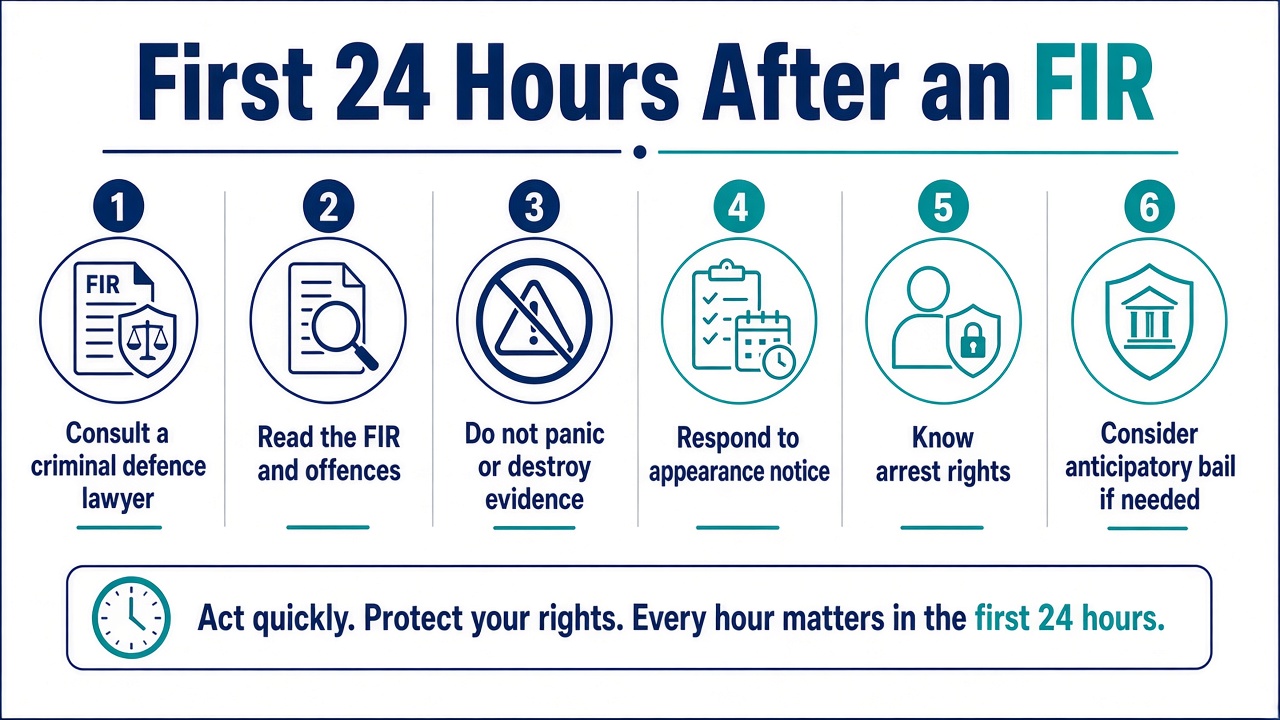
Consult a Criminal Defence Lawyer Immediately
As soon as you find out that an FIR has been filed against you, you should contact a criminal defence lawyer. Hand the lawyer a copy of the FIR and give them complete information about the circumstances. They will examine the BNS provisions, the allegations, whether the offences are bailable or non-bailable, the maximum punishment, the arrest requirements, the need to give notice of appearance, and the various possible bail options.
According to Section 173 BNSS, some offences can be reported electronically or regardless of territorial jurisdiction. In cases where the penalty is 3 to 7 years, a preliminary inquiry will be conducted with the prior approval of a DSP.
Read the FIR and Check the Offences
Take a look at the FIR rather than only checking if your name is listed. Make sure to examine the sections cited, the nature of the offences, the question of bail, the maximum possible punishment, the specific allegations, and the details of the other persons accused. Special attention should be given to whether the alleged offence involves a sentence of less than seven years or seven years or more, because this may influence the arrest procedure under Section 35 BNSS.
Remember: FIR Registration Does Not Mean Automatic Arrest
An FIR initiates a criminal investigation but does not result in guilt being established or in an automatic arrest being made. For offences punishable with imprisonment for less than seven years, Section 35 of the BNSS includes conditions under which an arrest may be made.
If arrest is not required, the police can issue a written notice to appear under Section 35(3) asking for your cooperation. The principles set out in Arnesh Kumar v. State of Bihar are still used to ensure protection against unnecessary arrests. You need not panic or hide yourself. Instead, get legal advice and respond in the appropriate way to the investigation.
Don't panic, flee, or destroy any evidence
An FIR may lead to anxiety, but if you flee, face the complainant, or destroy evidence, you can face additional legal difficulties. You should get immediate legal advice and then act according to your lawyer's instructions rather than trying to avoid the investigation.
Keep the relevant emails, messages, WhatsApp conversations, contracts, invoices, payment records, photographs, videos, communications on social media, travel records, and all other documents related to the allegations. Do not delete, change, or destroy any evidence. In the case of electronic evidence, you should keep the original material and not depend only on screenshots or modified copies.
Carefully respond to a notice of appearance
When you get a Section 35(3) BNSS notice, you should read it carefully and show it to your lawyer right away. The notice says that you have to appear and cooperate with the investigation, and it must not be ignored. In cases where a person complies with the notice, arrest is usually not allowed unless the police give reasons and meet the relevant statutory requirements.
The level of protection available will depend on the allegations and the circumstances. Your lawyer will tell you the date, place and way in which you have to appear as well as any further legal protection.
Know the Rights If You Are Arrested
If you are arrested, you are entitled to important constitutional and statutory protection. Article 22 and Section 47 of the BNSS guarantee your right to be informed of the reasons for your arrest and, where applicable, your right to bail. According to Section 48 of the BNSS, a relative, a friend or a person you have nominated must be made aware of your arrest and of the place where you are being detained. Article 22 also includes the right to consult a legal practitioner and to have one defend you. Contact a lawyer as soon as possible and act on the legal advice you receive about the investigation and the bail proceedings.
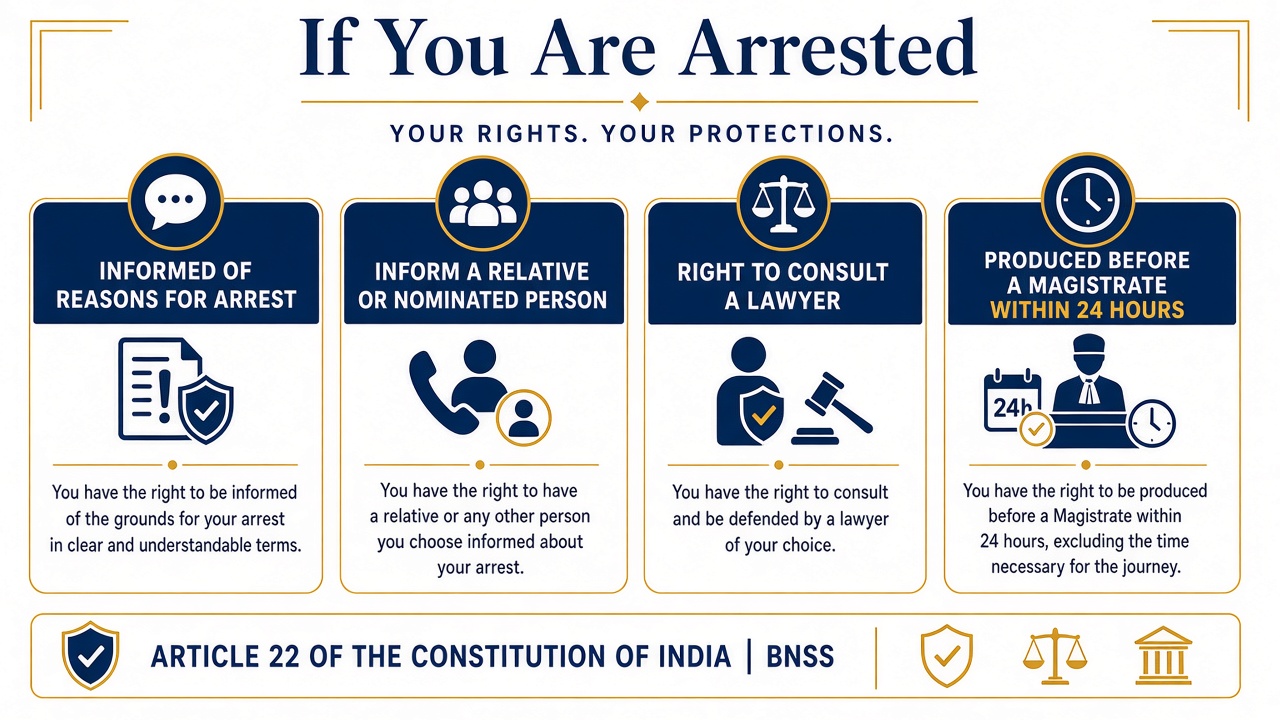
Understand the 24-hour Magistrate Rule
The provisions of Section 58 BNSS state that someone who is arrested without a warrant cannot generally be kept in custody for more than 24 hours, apart from the time necessary for travelling to the Magistrate's court, unless a Magistrate grants permission for further detention. Likewise, Article 22(2) requires that a person be presented before the nearest Magistrate within 24 hours, excluding the time taken for the journey.
Consider Anticipatory Bail If You Fear Arrest
Should you reasonably expect to be arrested in connection with a non-bailable offence, your lawyer might recommend that you apply for anticipatory bail under Section 482 of the BNSS before the Sessions Court or the High Court. However, Section 482 does not cover cases which involve Section 65 of the BNS or Section 70(2) of the BNS. If arrest is a genuine possibility, you should get legal advice as soon as possible rather than delaying until arrest is about to take place.
Apply for regular bail after Arrest
If you have already been arrested, the appropriate course of action will be to apply for bail. The bail rules in the BNSS vary according to the type of offence and the stage reached in the proceedings, and section 483 of the BNSS confers special powers on the High Court and the Court of Session in suitable cases.
The specific court and provision that apply in your case will vary according to the offence, the court in which the case is currently pending, and other circumstances.
Your lawyer will be able to find out where the bail application should be submitted and what reasons should be given.
Consider Quashing of the FIR in Appropriate Cases
In some cases, an accused may have the ground to approach the High Court to oppose the continuation of the criminal proceedings.
The High Court's inherent powers are retained by Section 528 BNSS so that it can make orders which are necessary for the purpose of giving effect to an order under the BNSS, for the purpose of avoiding the abuse of the procedures of any court, or for other purposes connected with securing the ends of justice.
Conclusion
An FIR represents a serious legal situation, but registering one does not amount to being arrested or convicted. During the first 24 hours, you should focus on understanding the charges, get some professional legal advice, evaluate the risk of arrest, and keep any evidence.
Arrest must not be carried out automatically in cases where the penalty is less than seven years' imprisonment. It is important to consider the need for arrest pursuant to Section 35 BNSS and the principles established by the Supreme Court, such as those set out in Arnesh Kumar.
Disclaimer: This article is for general informational and educational use only and should not be regarded as legal advice. Because procedures in criminal law and the way cases are interpreted by the courts may change, you should seek advice from a qualified lawyer concerning your particular situation.
FAQs
- Does the FIR filing lead to my immediate arrest?
No, FIR registration does not lead to arrest automatically. In some cases, Section 35 of the BNSS requires the police to consider whether an arrest is necessary and to serve a notice of appearance where appropriate. - What to do after an FIR has been filed?
Get the FIR, consult a criminal defence lawyer, find out which sections have been mentioned, keep any relevant evidence, and decide if you need anticipatory bail or some other legal remedy. - What will occur if I get a Section 35(3) notice?
You must attend and assist with the investigation if you receive a notice under Section 35(3). It is important not to ignore it; you should consult your lawyer and carry out the requirements set out in the notice unless you are able to challenge it legally. - How soon arrested person must be produced before a Magistrate?
According to Article 22(2) and Section 58 of the BNSS, a person who has been arrested must usually be presented before the closest Magistrate within 24 hours, provided that the time needed for the journey is excluded. - Can I seek anticipatory bail after an FIR has been registered?
Yes, if you suspect that you are going to be arrested for an offence that is not bailable, then you can apply for anticipatory bail under section 482 of the BNSS, provided that the statutory restrictions apply and the court considers the matter.
Share:
Table of Contents
No headings found in this post
Unlock smarter meetings with AI. Explore Liznr for product updates, success stories & collaboration insights.

Useful links
liznr.ai Blog
Check out the Liznr Legal blog for research, drafting and citation notes written for practising Indian advocates.
Subscribe to Our Newsletter