
Blogs
Cheque Bounce Case Under Section 138 NI Act: Full Step-by-Step Process and Timelines
👤 David Charles
Oct 12, 2026
Cheque Bounce Case Under Section 138 NI Act: Full Step-by-Step Process and Timelines
A cheque bounce case under Section 138 of the Negotiable Instruments Act, 1881 (NI Act) occurs when the cheque is dishonoured, and the person who issued it fails to pay the amount even after getting the statutory demand notice. The law treats dishonour of a cheque for insufficiency of funds or some other reasons as a criminal offence, but only if the strict sequence of steps and timelines is followed.
The simple chain is that the cheque should be presented within the validity period. The payee should send the written demand notice within 30 days of getting the bank's dishonour memo. In this blog, we explain the process, timelines, jurisdiction, and compensation-related provisions of a cheque bounce case under Section 138 of the NI Act.
What is 'cheque bounce' under Section 138?
The statutory conditions applying to Section 138 of the NI Act are that it comes into force where a cheque issued to pay, either entirely or in part, a legally enforceable debt or other liability is returned by the bank unpaid due to insufficient funds or because it goes beyond the arrangement agreed with the bank.
Criminal liability may result, but the prescribed statutory procedure must be observed.
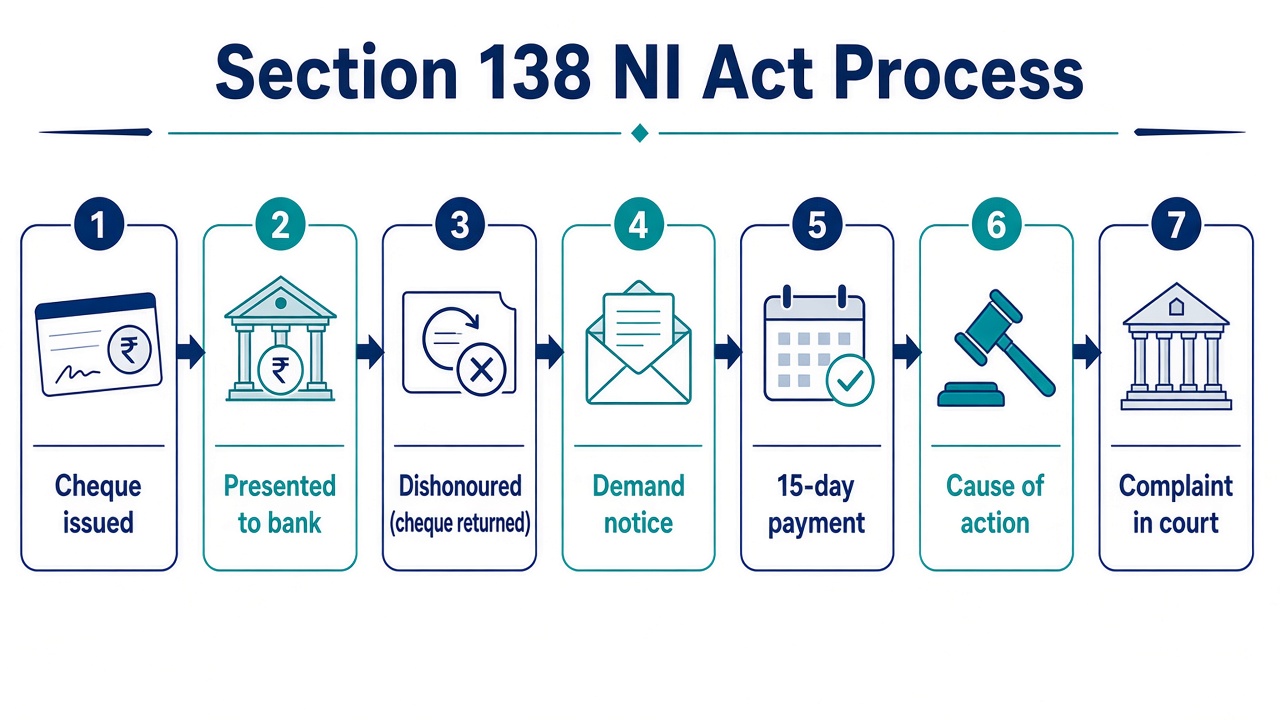
A typical Section 138 case follows this chain:
- Cheque issued
- Cheque presented
- Cheque dishonoured
- Demand notice
- 15-day payment period
- Cause of action
- Complaint before the court
The timelines in each stage are important.
Step 1: Cheque Is Issued and Presented
The procedure starts when the drawer draws a cheque on the payee as payment towards a debt or liability. The payee has to take the cheque to the bank within three months of the date on which the cheque was issued, unless the cheque states a shorter validity period.
The cheque can be presented by the payee either through their own bank for collection or by going directly to the drawee bank, and this method of presentation may later affect the territorial jurisdiction.
Hold on to the original cheque, the counterfoil, the bank deposit slip, and any acknowledgment sent by the bank in safe custody. These documents can be used to establish when the cheque was issued, when it was presented, and when it was dishonoured.
Step 2: Bank Returns the Cheque Unpaid
When a cheque is dishonoured, the bank will send out a return memo or a cheque-return memo giving the reason for the dishonour. Typical reasons are insufficient funds, signature mismatch, account closed, payment stopped by drawer, not authentic alterations, or cheque stale or out of date.
With regard to Section 138, the relevant statutory provision mainly deals with dishonour resulting from insufficient funds or because the amount in question is more than that which the drawer had arranged with the bank. Other reasons for dishonour may call for separate legal analysis and do not automatically come within the scope of Section 138.
The payee must get and keep the original return memo because the date on which they receive it is significant, as the 30-day period during which the demand notice has to be sent usually starts on the date that the payee receives from the bank information about the dishonour.
Step 3: Send a Demand Notice Within 30 Days
On receiving the bank's notice of dishonour, the payee or the holder in due course has to send a written notice of demand to the drawer within 30 days. The notice must state the cheque number, amount, date, and drawee bank, the date on which the cheque is presented, date and reason for dishonour as mentioned in the return memo.
- The debt or liability for which the cheque was issued
- A demand for payment of the cheque amount
- A clear warning that failure to pay within 15 days of receipt may result in a criminal complaint under Section 138 NI Act
The notice should be sent to the drawer at the correct address, and it is advisable to use registered post with acknowledgment and also to use a traceable courier or email if suitable. You should keep the postal receipts, the tracking records, the delivery confirmation and a copy of the notice.
The thirty-day period is not one during which the drawer is required to respond; it is the time in which the payee must serve the statutory demand notice after having received the bank's dishonour information.
Step 4: Drawer Has 15 Days To Pay
When the drawer has received the notice of demand, the law provides it with 15 days in which to pay the amount of the cheque to the payee or to the holder in due course.
So long as the drawer makes payment within this time frame, the statutory consequence provided for in Section 138 will generally not occur because the debt by means of the cheque has been discharged; payment must be made by a method which can be traced, and the payee should then give a proper receipt or acknowledgement.
When the drawer has not paid within 15 days of receiving the notice, the right to bring a Section 138 complaint comes into existence. The complaint must then be filed within one month of the date on which this right arises, provided that the court is able to grant an extension of time if sufficient cause is shown.
Step 5: File the Complaint Within One Month
Should payment not be made within the 15-day period, the payee can submit a written complaint to the jurisdictional Magistrate. However, according to Section 142 of the NI Act, the complaint must usually be filed within one month of the date on which the cause of action arose as specified in clause (c) of the proviso to Section 138.
The action can be brought the day after the 15-day period has expired because the drawer received the notice; it is therefore that the one-month limitation period begins on the day following the expiry of those 15 days. The complaint should include
- The complainant's details
- The accused drawer's details
- Facts showing the debt or liability
- Cheque details and the date of issuance
- Date and mode of presentation
- Bank return memo and reason for dishonour
- Date of receipt of the dishonour information
- Copy of the statutory demand notice and proof of service
- Statement that 15 days have expired without payment
- List of witnesses and supporting documents
The complaint has to be supported by an affidavit and must include the original cheque, the original bank return memo, and evidence that the statutory notice was served on the drawer.
Key Timelines at a Glance
Here are the timelines of the cheque bounce case
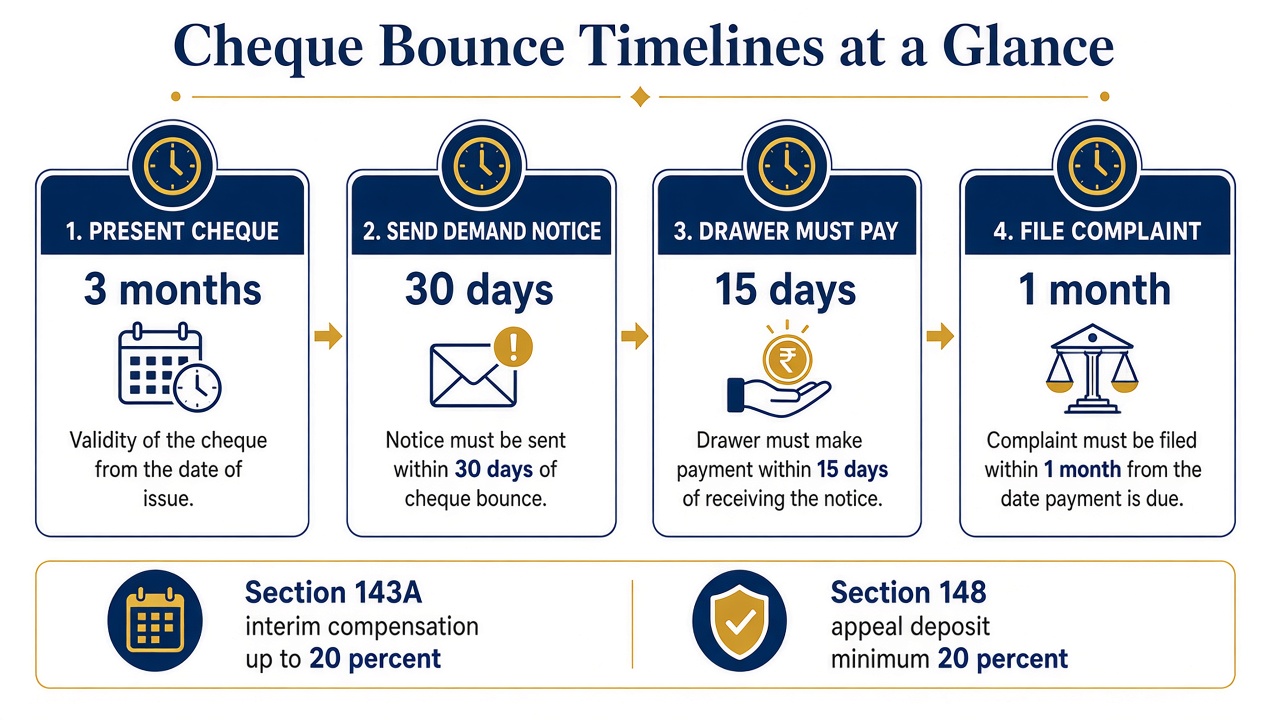
| Stage | Timeline |
|---|---|
| Present cheque to bank | Within three months from the date of the cheque, or within its validity period, whichever is earlier. |
| Send statutory demand notice | Within 30 days of receiving information from the bank about dishonour. |
| Drawer to pay cheque amount | Within 15 days of receiving the demand notice. |
| File complaint | Within one month after the cause of action arises, subject to condonation of delay for sufficient cause. |
| Interim compensation | Up to 20 % of the cheque amount, if directed by the trial court under Section 143A. |
| Deposit pending appeal | Minimum 20 % of the fine or compensation awarded by the trial court, if directed by the appellate court under Section 148. |
Conclusion
A case involving a bounced cheque under Section 138 of the NI Act has to follow a strict statutory procedure. The cheque should usually be presented within three months; the demand notice must be sent within 30 days of receiving information that the cheque has been dishonoured. The drawer is given 15 days to make the payment after receiving the notice, and the complaint must generally be filed within one month of the cause of action arising.
The rules in Section 142(2) deal with territorial jurisdiction, and Section 139 sets up a presumption about the debt or liability which can be challenged. Furthermore, Sections 143A and 148 may also have financial implications in the course of the proceedings and appeals. Because there are strict time limits in these cases, both the person making the complaint and the accused should get the right legal advice as soon as possible.
FAQs
- What is the time limit to send a legal notice after a cheque bounces?
The payee should send the written demand notice within 30 days of getting information from the bank about dishonor. The notice should demand payment and give the drawer 15 days to pay. - How much time does the cheque issuer have to pay?
The drawer has 15 days from getting the demand notice to pay the cheque amount. If the payment is not made in this period, then the payee should initiate proceedings under Section 138 of the NI Act. - When should a cheque-bounce complaint be filed?
A Section 138 complaint must be filed within 1 month after case of action occurs, after expiry of the 15-day payment period. Courts may condone delay for sufficient cause.
Share:
Table of Contents
No headings found in this post
Unlock smarter meetings with AI. Explore Liznr for product updates, success stories & collaboration insights.

Useful links
liznr.ai Blog
Check out the Liznr Legal blog for research, drafting and citation notes written for practising Indian advocates.
Subscribe to Our Newsletter