
Blogs
Bare Acts vs Commentaries vs Case Law: When to Use What in Legal Research
👤 David Charles
May 31, 2026
Bare Acts vs Commentaries vs Case Law: When to Use What in Legal Research
Legal research requires more than finding laws. It is about understanding where to get the right legal information and how to use it properly. Many junior advocates and law students are often confused between the case law, commentaries, bare acts, etc during drafting and case preparation.
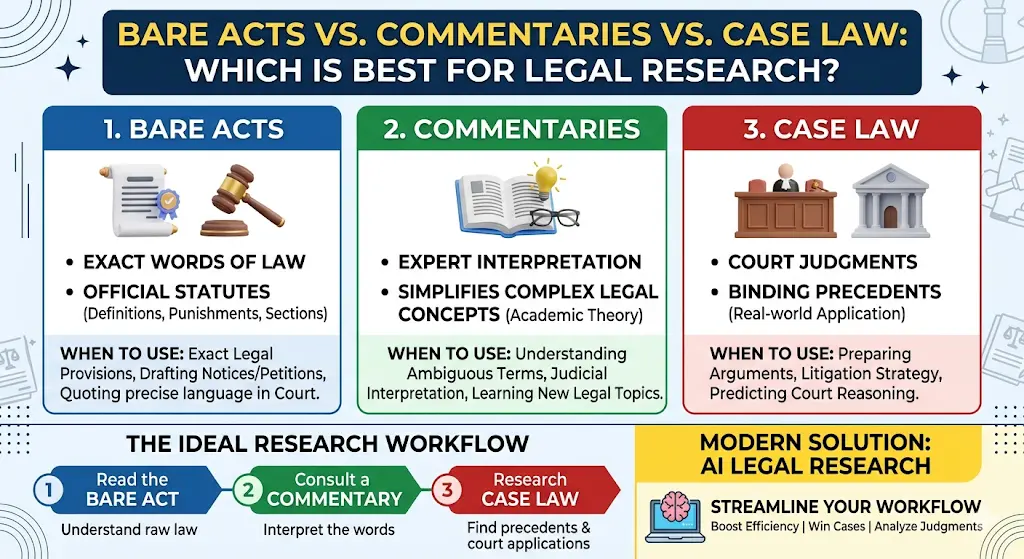
A Bare Act gives the exact wording of law, case law shows how courts apply laws in real disputes, and commentaries explain legal concepts in a simpler way. Modern AI research platforms like Liznr Legal simplify the process, organize precedents, analyze judgments, and structure legal research faster. Read this complete blog to know the difference between the Bare Acts, Commentaries, and Case Law and find the best option for legal research.
What Is a Bare Act?
The Bare Act refers to the official text of a law passed by the legislature without any explanation or interpretation. It includes sections, definitions, punishments, procedures, and amendments exactly as they appear in the statute. Lawyers refer to Bare Acts to grasp the exact legal wording before drafting arguments, petitions, or legal notices.
When Should You Use a Bare Act?
Here are the scenarios when you can use the bare act.
- For Exact Legal Provisions
You can use it to check specific legal provisions, definitions, procedural rules, punishments, or statutory requirements while working on legal drafts. - Before Case Law Research
Before making judgements, you should use this act and understand the original language and structure of the applicable legal section. - During Legal Drafting
It is also used to draft bail applications, notices, petitions, contracts, and replies that require precise statutory references and language. - To Verify Amendments
If you want to confirm the updated terminology, recent amendments, and changes introduced by new criminal or civil laws, then you can use this bare act. - To Understand Legal Ingredients
Bare Acts help identify the elements of offenses, procedural timelines, jurisdiction rules, and powers granted by specific statutory provisions. - During Court Arguments
Lawyers can also use the Bare Acts in court to quote precise legislative language to judges and opposing counsel.
What Are Legal Commentaries?
Legal commentaries are referred to as the explanatory texts written by senior advocates, judges, legal professionals, or scholars. It clarifies complex legal provisions by discussing concepts, judicial interpretations, and practical applications in an accessible format. Commentaries help readers to understand how laws function beyond the statutory language found in Bare Acts.
When Should You Use Commentaries?
Using commentaries is recommended to simplify the complex law, learn new subjects, understand judicial interpretation, or for other purposes. Here are the situations when you use it.
- To Simplify Complex Law
If you are unable to interpret languages in bare acts and are seeking practical interpretation with examples, then you can use commentaries. - While Learning New Subjects
You can use it to learn new legal topics, doctrines, procedural concepts, or complex statutory frameworks during legal studies and practice. - To Understand Judicial Interpretation
It is used to understand conflicting judicial opinions, legal principles, exceptions, and the historical background of important statutory provisions. - Before Deep Legal Research
If you are going to conduct deep legal research and first want to build strong knowledge of specific legal issues, then you can use commentaries and gather essential information. - During Drafting Preparation
Lawyers can use commentaries while drafting to grasp procedural requirements, interpretation issues, and the practical application of legal provisions. - To Study Landmark Judgments
Commentaries organize long statutes by presenting important concepts, landmark judgments, and legal explanations in a more readable format.
What Is Case Law?
Case law involves the judgments made by courts when resolving legal disputes. These decisions set legal precedents and interpret statutes for future cases.
When Should You Use Case Law?
Here are the situations when you can use the case law.
- While Preparing Arguments
Judges who want to prepare arguments for the court can use case law. - When Law Is Ambiguous
Refer to case law when statutory language is unclear or requires judicial interpretation for proper understanding and application. - To Understand Practical Application
It helps lawyers to see how courts apply procedural rules and legal principles in real situations and disputes. - To Build Litigation Strategy
If you want to identify successful legal arguments, common counterarguments, and litigation strategies while using judgments, then you can use case law. - To Predict Court Approach
Lawyers review case law to gauge possible court reasoning, judicial trends, and likely outcomes in ongoing or upcoming litigation.
The Ideal Research Workflow
Proper legal research requires following a structured process. So, don't jump directly into searching judgments; you should follow the step-by-step workflow from statutory law to interpretation and then practical judicial application. This approach improves your understanding, saves time, and strengthens legal arguments. Here are the steps you can follow to make legal judgments.
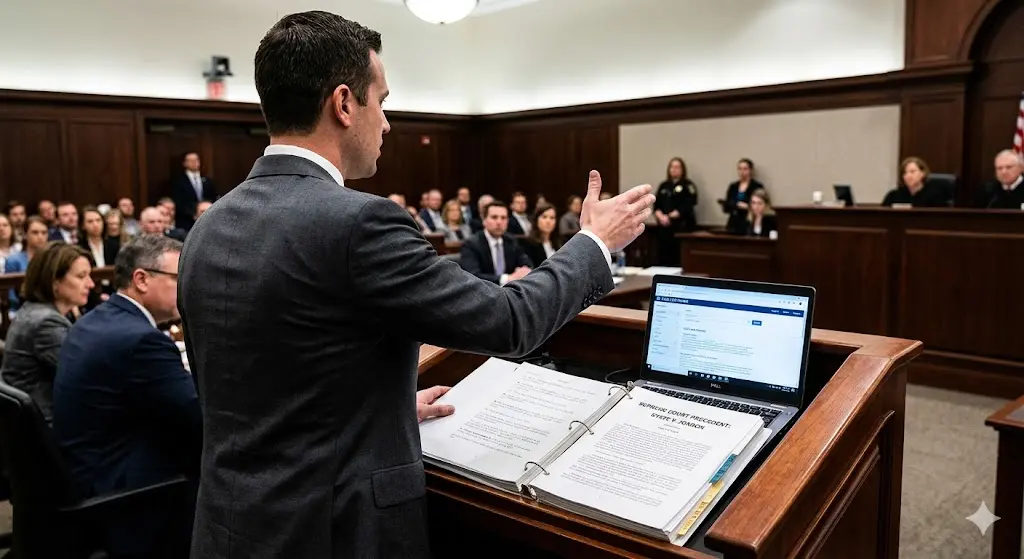
- Step 1: Read the Bare Act
First, use the Bare Act to understand the exact wording, definitions, elements, and procedural requirements of the law. - Step 2: Consult a Commentary
Next, use the commentaries to grasp legal concepts, judicial interpretation, exceptions, and important cases related to the provision. - Step 3: Research Case Law
Study binding precedents and recent judgments to make strong arguments and understand how courts apply the law in practice.
Summary: The Research Funnel At a Glance
Here is the comparison table on the Bare Act, case law, and Commentaries.
| Research Asset | What It Answers | Used For |
|---|---|---|
| Bare Act | "What does the raw law actually state?" | Foundations, identify the core statutory elements and limitation dates. |
| Commentary | "What do the words mean and why?" | Deep conceptual hurdles, academic theory, and unique legal issues. |
| Case Law | "How is this applied in court right now?" | Binding precedents, courtroom arguments, and matching factual matrices. |
Conclusion
Good legal research is not only about how many hours you spend on digging up statutes and judgments, but it is also about how effectively you use them to win your case. You must transition from Bare Act components to binding Case Law, and use the AI tool like Liznr Legal to shorten your research workflow to just 25 minutes. It allows you to easily handle 3 to 4 times more cases each month, boost your revenue, and enter every courtroom fully prepared for both sides.
FAQs
- If Case Law contradicts a Bare Act, which one takes precedence?
The legislature writes the law (Bare Act), and the judiciary interprets it. If a statutory provision is unclear, the interpretation by the Supreme Court becomes the law. However, a court cannot change a completely clear statute unless it finds that specific provision unconstitutional. - Is it safe to rely only on Case Law without checking the Bare Act?
No, don't rely on case law only without checking the bare act. Amendments can change or remove sections of a Bare Act, making older Case Law completely outdated or irrelevant. So you must check that the statutory foundation of a precedent is still valid. - How do I know if a Commentary is authoritative enough to cite in court?
While commentaries are not binding law, those by respected legal scholars hold substantial persuasive weight. Judges often reference these specific commentaries in their rulings to support their reasoning. - Does Liznr Legal use generic, public AI data for its research?
Unlike public AI tools that gather random data from the internet and can fabricate legal citations, Liznr Legal employs a secure model trained exclusively on actual Indian Supreme Court and High Court judgments, genuine statutory gazettes, and verified legal frameworks. - Can I use Liznr Legal to draft court applications based on my research?
Yes, you can use this tool to draft court applications. It helps you to process your case details, produce structured, legally sound first drafts of Bail Applications, petitions, notices, or replies in your chosen language (support English, Hindi, and Hinglish).
Share:
Table of Contents
No headings found in this post
Unlock smarter meetings with AI. Explore Liznr for product updates, success stories & collaboration insights.
Related legal Posts


Useful links
liznr.ai Blog
Check out the Liznr blog for expert tips, inspiring customer stories, and smart strategies on productivity, remote work, and making the most of meetings.
Subscribe to Our Newsletter